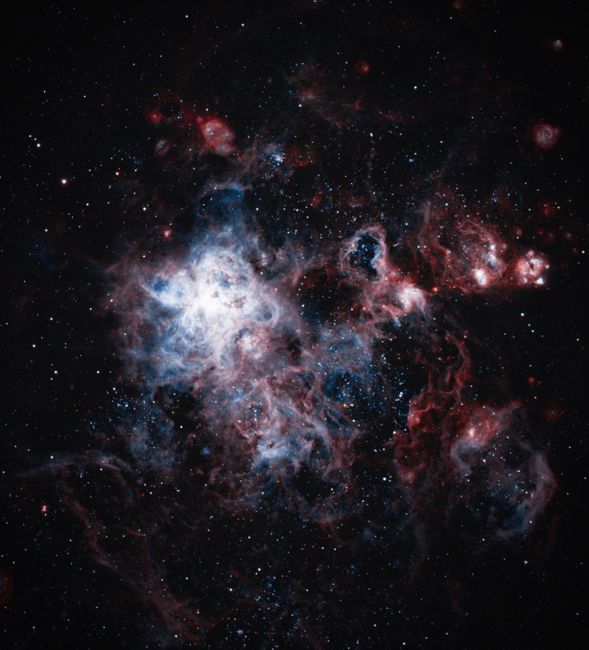
Astronomers Observe Rare Supernova Explosion in Distant Galaxy
The Gemini South telescope has captured a bright stellar explosion, providing researchers with a unique opportunity to study the event in real time.

PENN Explainer
Hear this story explained in 90 seconds.
Astronomers using the Gemini South telescope have successfully captured images of a new supernova, designated SN 2026ahvu. This stellar explosion was observed as it began to brighten, offering a rare chance for scientists to monitor the process from its early stages. The facility is operated by the National Science Foundation's NOIRLab and is located in the Southern Hemisphere.
Supernovae are the dramatic final stages of a star's life, often resulting in a massive release of energy and light. By observing these events as they unfold, researchers can gather data on the chemical composition and physical dynamics of the dying star. This specific event provides a valuable opportunity to study the mechanics of stellar death in high detail.
Data collected from such observations help astronomers refine their models of how stars evolve and eventually collapse. The light from SN 2026ahvu is being analyzed to determine the mass and type of the progenitor star. Understanding these explosions is essential for mapping the history of the universe and the distribution of elements.
Gemini South is part of a global network of telescopes that allows for continuous monitoring of the night sky. Its location in Chile provides a clear view of the southern celestial hemisphere, which is home to many significant astronomical targets. The telescope's advanced instrumentation allows it to detect faint signals that might otherwise be missed.
This discovery adds to a growing body of knowledge regarding transient astrophysical phenomena. Scientists often rely on automated surveys to alert them to sudden changes in the brightness of distant stars. Once an alert is triggered, specialized facilities like Gemini South are used to conduct follow-up observations.
International collaboration remains a cornerstone of modern astronomy, as researchers share data across borders to maximize scientific output. The study of SN 2026ahvu involves teams from various institutions working to interpret the incoming light signatures. These efforts ensure that the information gained is verified and accessible to the broader scientific community.
Beyond the immediate study of this supernova, the event serves as a test for new observational techniques. Astronomers are constantly improving their ability to filter out background noise and focus on specific cosmic signals. Such advancements are critical for future missions that aim to explore even more distant regions of space.
As the supernova continues to evolve, researchers expect to collect more data on its cooling phase and chemical output. This information will be compared against existing theories to see if current models of stellar evolution hold up under scrutiny. Each new observation helps to fill gaps in our understanding of the life cycles of stars.
Public interest in such discoveries highlights the ongoing fascination with the cosmos and the processes that shape it. While these events occur millions of light-years away, they are fundamental to the existence of the solar system and the elements that make up life on Earth. Continued investment in ground-based observatories ensures that humanity remains capable of witnessing these cosmic milestones.
Future research will likely focus on the remnants left behind by this explosion, such as neutron stars or black holes. By tracking the expansion of the debris cloud, scientists can learn more about the environment surrounding the original star. These ongoing studies represent the next steps in a long-term effort to decode the history of the galaxy.
You've reached your free article limit
You've read 10 of 10 free articles this month. Subscribe to Planet Earth News Network for unlimited access to neutral, global journalism — plus puzzles, podcasts, and the weekly newsletter.
Already a subscriber? Sign in.
Ask the Author
Subscribers can ask the journalist a question about this story. Subscribe to ask.
Neutrality note
Auto-harvested from global news wires and presented neutrally by PENN.
to vote
Comments
No comments yet — be the first to share your thoughts.
Related stories in Space & Astronomy

Starfish Space Concludes Mission After Losing Contact with Otter Satellite
2026-11-14
United Arab Emirates Advances Earth Observation with Sirb-1 Satellite Project
2026-11-14