Community of the Day: Windhoek, Namibia
Discover the vibrant capital nestled high in the Khomas Highlands

PENN Explainer
Hear this story explained in 90 seconds.
Windhoek, Namibia
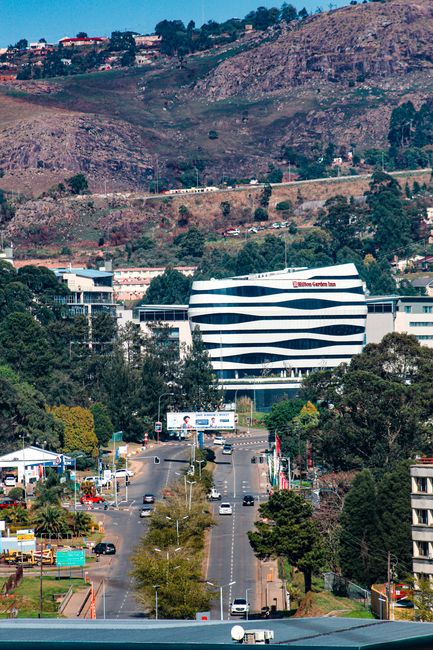
Surrounded by rolling highland ridges and dry acacia savanna, Windhoek is the lively political, cultural, and economic heart of Namibia. Blending indigenous heritage, colonial architectural relics, and modern African energy, this high-altitude capital offers a distinctive urban atmosphere against a vast arid landscape.
- Windhoek sits at an elevation of roughly 1,654 meters (around 5,428 feet) above sea level in a highland basin framed by the Auas, Eros, and Khomas mountains according to Encyclopaedia Britannica and South African History Online. This geographic setting gifts the capital with a dry semi-desert climate characterized by temperate, sun-drenched days, crisp highland evenings, and low humidity year-round. Surrounding mountain topography defines the limits of the city basin, steering modern infrastructural expansion predominantly northwards toward Brakwater as documented by Wikipedia.
- Before formal colonial boundary demarcations, local African pastoralist groups recognized the basin primarily for its natural hot springs as noted by South African History Online. The Damara people called the region /Ais //Gams, meaning 'firewater,' while the Herero referred to it as Otjomuise, signifying a 'place of steam.' Around 1840, the Nama leader Jonker Afrikaner settled his followers in the area and popularized the name Winterhoek after his ancestral birthplace in South Africa, which eventually morphed into modern Windhoek according to South African History Online.
- Windhoek witnessed significant architectural transformation after Imperial Germany established German South-West Africa in 1890, creating a colonial headquarters overseen by Major Curt von François as detailed by African Travel and Great Africa. Landmark structures such as the neo-Romanesque Christuskirche and the fortress of Alte Feste continue to stand prominently in the city center. Following World War I, South Africa assumed control of the territory, adding further architectural and geopolitical layers until national independence in 1990 as outlined by Micato Safaris.
- Under twentieth-century apartheid-style segregation administered by South Africa, the municipal layout was rigidly partitioned along racial divisions into central suburban zones, Khomasdal, and Katutura as explained by South African History Online. The township of Katutura, whose Herero name loosely translates to 'the place where people do not want to live,' arose from forced removals during the late 1950s. Today, Katutura has evolved into one of Windhoek’s most resilient and culturally dynamic districts, famous for bustling open-air markets, social enterprise initiatives, and communal gathering spaces.
- As the primary engine of Namibia's national economy, Windhoek provides the overwhelming majority of the country's non-agricultural employment, utility infrastructure, and commercial transactions according to Wikipedia. The capital hosts corporate headquarters, banking institutions, and the stock exchange, serving as a vital nexus for retail and light manufacturing. The city's centralized economic footprint draws skilled professionals and entrepreneurs from across southern Africa, accelerating urban development.
- Namibia's status as a drought-prone nation makes water security a top priority, and Windhoek became a world pioneer in sustainable water resource management. In 1968, the city built the Goreangab Reclamation Plant, becoming one of the earliest municipalities globally to recycle treated wastewater directly into potable drinking water. This cutting-edge reclamation infrastructure remains a gold standard for arid-zone urban planning and international environmental engineering.
- Culinary traditions in Windhoek reflect a fusion of Germanic baking, Dutch colonial influences, and indigenous open-fire cooking techniques as highlighted by South African History Online. Street food lovers flock to township markets such as Single Quarters to savor freshly grilled kapana, thinly sliced spiced beef prepared over glowing charcoal braziers. Traditional European bakeries serving strudel and pretzels coexist alongside lively eateries specializing in game meats like oryx, kudu, and springbok.
- Namibia is celebrated for maintaining the legendary Reinheitsgebot German beer purity law dating back to 1516, and Windhoek is the capital of this craft. The Namibia Breweries Limited facility produces iconic lagers brewed strictly with water, malted barley, and hops, free from added adjuncts or artificial preservatives. Windhoek Lager is globally exported and stands as a recognized symbol of local industrial pride and international commerce.
- The skyline of modern Windhoek changed dramatically in the twenty-first century with the construction of monumental public works commemorating national sovereignty. The Independence Memorial Museum, constructed through international collaboration and opened in 2014, towers above the central district with panoramic views across the valley. Nearby, the grand Tintenpalast, historically nicknamed the 'Ink Palace' for its high paperwork volume during colonial rule, now serves as the seat of the National Assembly of Namibia.
- Because of its crystal-clear desert air, high plateau elevation, and minimal urban light spill relative to major world metropolises, Windhoek serves as an exceptional vantage point for astronomy. Amateurs and professional stargazers take advantage of the southern sky’s unhindered visibility, observing brilliant displays of the Milky Way, Magellanic Clouds, and Southern Cross. The region regularly attracts international astronomical enthusiasts who use the capital as a launching pad to explore deep-sky reserves throughout the Khomas plateau.
Photo Gallery
Ask the Author
Subscribers can ask the journalist a question about this story. Subscribe to ask.
নিরপেক্ষতা নোট
Community of the Day feature by PENN editorial.
to vote
Comments
No comments yet — be the first to share your thoughts.
Author
Planet Earth News Travel DeskSenior Editor, Planet Earth News Network
View all articles by Desk →