Culinary Tradition of the Day: Churchkhela
Exploring the history and craft of Georgia's iconic candle-shaped nut candy
Hear this story explained in 90 seconds.
Churchkhela
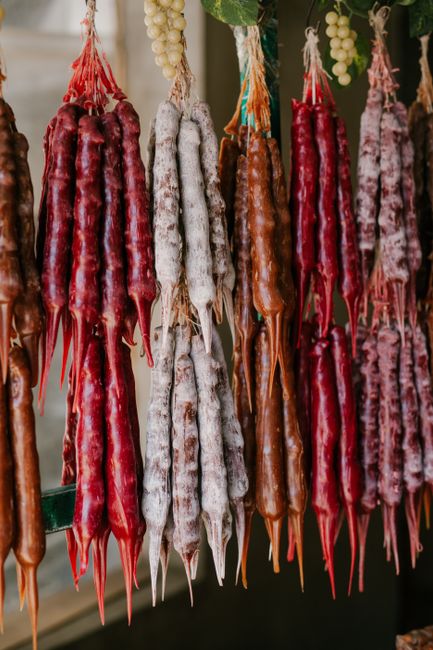
Churchkhela is a traditional Georgian confection that resembles a candle or a rustic sausage in appearance. It is crafted by threading nuts onto a string and dipping them repeatedly into a thickened grape must mixture. This unique treat serves as a staple of Georgian culinary heritage, celebrated for its natural ingredients and long shelf life.
History
The origins of churchkhela are deeply intertwined with the ancient winemaking traditions of the Caucasus region, which date back thousands of years. According to the Slow Food Foundation, the practice of preserving surplus grape must by concentrating it around nuts has been documented for several centuries. Archaeological excavations in Georgia have uncovered clay vessels that chemical analysis suggests were used for storing these confections, indicating a long-standing role in the local diet. Historically, Georgian warriors carried churchkhela on long journeys because it provided a dense, portable source of energy that remained stable without special preservation.
Cultural Significance
Churchkhela is more than a snack; it is a seasonal marker of the autumn harvest. As noted by the Slow Food Foundation, production typically coincides with the ripening of nuts and the pressing of grapes for wine. The sweet is deeply embedded in the social fabric of Georgia, often found hanging in storefronts or sold at local markets like the Dezerter Bazaar in Tbilisi. It is widely regarded as a national treasure, and in 2011, the Ministry of Agriculture of Georgia registered it as a protected geographical indication to preserve its traditional production methods.
How It Works
The preparation of churchkhela is a labor-intensive process that mirrors traditional candle making. First, walnuts, hazelnuts, or almonds are threaded onto a cotton string, which acts as a structural core for the candy. The liquid component, known as badagi, is created by boiling grape must until it reaches a high concentration of sugar. Wheat flour is then stirred into the hot juice to create a thick, elastic coating called tatara. The nut strings are dipped into this mixture, hung to dry, and then dipped again multiple times until the desired thickness and chewy texture are achieved.
Representative Recipe
Traditional Georgian Churchkhela
A chewy, nutrient-dense candy made from walnuts coated in a thickened, naturally sweet grape reduction.
Prep time: 60 min | Cook time: 120 min | Total time: 4 days | Yield: 10 pieces | Difficulty: Medium
Ingredients
- 500g shelled walnuts or hazelnuts
- 2 liters grape must (or high-quality unsweetened grape juice)
- 200g wheat flour
- 1 meter cotton thread
Instructions
- Thread the nuts onto the cotton string using a needle, leaving a loop at one end for hanging and a knot at the other to secure the nuts.
- Pour the grape must into a large pot and simmer over medium heat until it reduces by about one-third.
- Gradually whisk in the flour to the warm juice, ensuring no lumps remain, and continue to cook until the mixture thickens into a smooth, pudding-like consistency.
- Dip each string of nuts into the hot mixture, ensuring they are fully coated, and hang them on a rack to air-dry for several hours.
- Repeat the dipping process three to four times, allowing the candy to dry between each layer, until the coating is firm and elastic.
- Leave the churchkhela to hang in a cool, dry place for several days until the exterior is no longer sticky and the texture is firm to the touch.
Notes
Churchkhela is best stored in a cool, dry place and can last for several months. It is traditionally served sliced into rounds, making it an excellent accompaniment to tea or as a portable snack for hiking and travel.
You've reached your free article limit
You've read 10 of 10 free articles this month. Subscribe to Planet Earth News Network for unlimited access to neutral, global journalism — plus puzzles, podcasts, and the weekly newsletter.
Already a subscriber? Sign in.
Subscribers can ask the journalist a question about this story. Subscribe to ask.
Culinary Tradition of the Day feature by the PENN Food & Spirits Desk.
Comments
No comments yet — be the first to share your thoughts.
PENN's lifestyle and culinary department, covering global cuisine — the origins, traditions, and recipes behind the world's dishes, with deep histories and cultural context that go beyond the plate. and PENN's beverage-focused culinary team, dedicated to spirits and drinks — covering distilleries, breweries, and producers worldwide, with histories, tasting notes, professional reviews, and cocktail traditions.
View all articles by Desk →