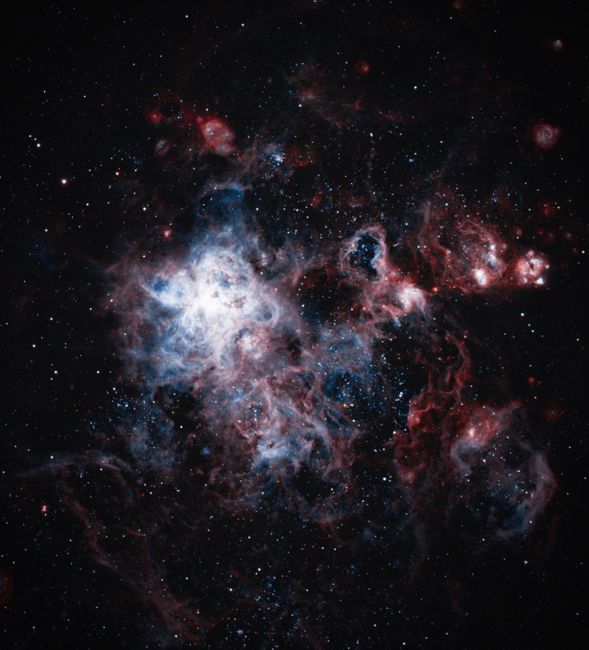
NASA's Nancy Grace Roman Space Telescope Begins Mission to Map the Cosmos
The new flagship observatory has reached its destination to study dark energy, dark matter, and thousands of distant exoplanets.

PENN Explainer
Hear this story explained in 90 seconds.
The Nancy Grace Roman Space Telescope has successfully reached its operational home in space to begin a new era of astronomical discovery. Launched aboard a SpaceX Falcon Heavy rocket from Kennedy Space Center, the observatory is now positioned at the second sun-Earth Lagrange point, known as L2. This location, situated 750,000 miles beyond the moon, serves as a stable parking spot for several major space observatories. The telescope is designed to expand upon the work of its predecessors, the Hubble and James Webb space telescopes.
While those instruments peer through a narrow keyhole at the universe, the Roman telescope is expected to provide a much wider view of the cosmos. NASA administrator Jared Isaacman stated that the mission will contribute to world-changing science and become a household name alongside other great instruments of discovery. The telescope will spend its first year conducting action-packed science observations, including the testing of its advanced coronagraph instrument. This technology will allow researchers to capture unprecedented images of exoplanets by blocking the blinding light of their host stars.
Nicky Fox, the associate administrator for NASA’s Science Mission Directorate, noted that the telescope's enormous datasets will help scientists tackle some of the biggest questions in astronomy. One of the primary goals for the mission is to increase the number of known exoplanets significantly, with expectations to identify up to 100,000 new worlds over the next five years. Beyond searching for planets, the observatory will map the distribution of dark matter and investigate the mysterious influence of dark energy on the expansion of the universe. Ami Choi, a research astrophysicist at NASA's Goddard Space Flight Center, explained that these observations could potentially contribute to a deeper understanding or even the collapse of major theories in modern physics.
The telescope features a 2.4-meter mirror and infrared capabilities that allow it to take thousands of images every day. Data collected by the mission will be beamed back to Earth, with international partners including Australia playing a key role in receiving these signals. Project manager Jackie Townsend confirmed that the team expects to release the first images and data from the telescope in approximately three months. As the mission progresses, the findings are expected to guide the development of future projects, such as NASA’s planned Habitable Worlds Observatory. This new flagship mission represents a significant step forward in humanity's ongoing effort to understand the structure of the universe and our place within it.
You've reached your free article limit
You've read 10 of 10 free articles this month. Subscribe to Planet Earth News Network for unlimited access to neutral, global journalism — plus puzzles, podcasts, and the weekly newsletter.
Already a subscriber? Sign in.
Ask the Author
Subscribers can ask the journalist a question about this story. Subscribe to ask.
Neutrality note
Auto-harvested from global news wires and presented neutrally by PENN.
to vote
Comments
No comments yet — be the first to share your thoughts.
Related stories in Space & Astronomy

Starfish Space Concludes Mission After Losing Contact with Otter Satellite
2026-11-14
United Arab Emirates Advances Earth Observation with Sirb-1 Satellite Project
2026-11-14