New Non-Invasive Brain-to-Text Technology Approaches Surgical Precision
Researchers have developed a system that decodes neural activity into coherent text without the need for invasive implants.
PENN Explainer
Hear this story explained in 90 seconds.
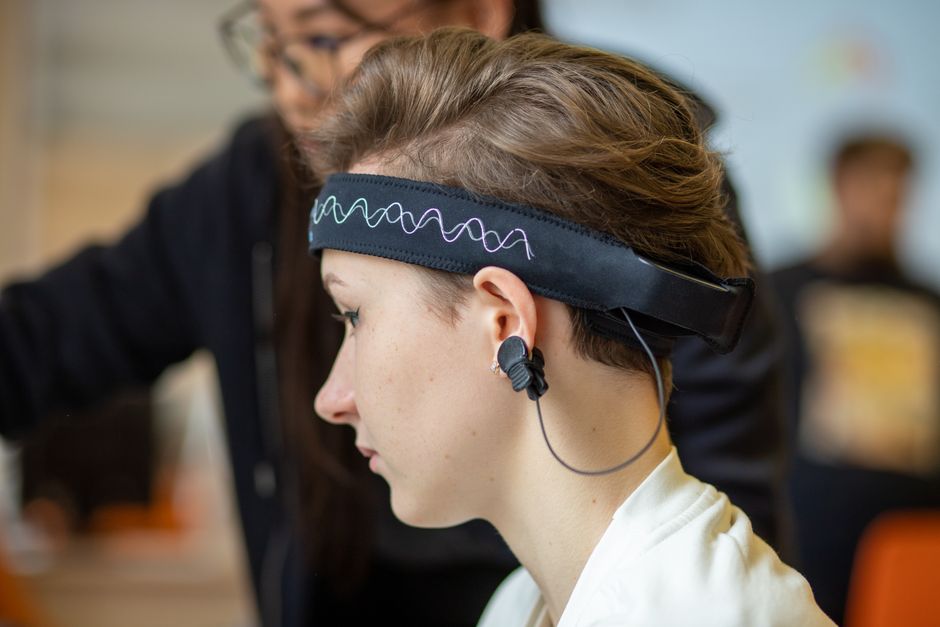
A team of researchers in Israel has unveiled a significant advancement in brain-computer interface technology that translates neural signals into written language. The system, known as Brain2Qwerty v2, utilizes a combination of magnetoencephalography recordings and advanced deep learning models to interpret brain activity. This development marks a notable step toward restoring communication for individuals who have lost the ability to speak due to neurological conditions or injuries. The technology currently achieves a sixty-one percent word accuracy rate, a level of performance that approaches the precision typically seen only in invasive surgical implants.
By avoiding the need for brain surgery, this non-invasive approach offers a safer and more accessible path for patients seeking to regain their voice. The system works by bridging noisy neural signals to coherent sentences through the use of sophisticated language models. These models are trained to recognize patterns in brain activity that correspond to specific words or concepts. As the technology matures, researchers believe it could provide a reliable method for communication that does not require permanent hardware inside the skull.
The project highlights the growing intersection of neuroscience and artificial intelligence in modern medical research. Experts in the field have noted that the ability to decode thoughts into text in real-time could fundamentally change how clinicians approach neuro-rehabilitation. While the current accuracy rate is impressive for a non-invasive device, the team is already working on further refinements to improve the system's reliability. Future iterations of the technology will likely focus on increasing the speed of translation and expanding the vocabulary the system can recognize.
The researchers aim to make the interface more intuitive for users, allowing for more natural and fluid communication. This breakthrough is part of a broader trend of using artificial intelligence to solve complex biological challenges. As these tools become more refined, they are expected to play an increasingly vital role in clinical settings worldwide. The team plans to conduct further testing to ensure the system remains effective across a diverse range of users and conditions.
You've reached your free article limit
You've read 10 of 10 free articles this month. Subscribe to Planet Earth News Network for unlimited access to neutral, global journalism — plus puzzles, podcasts, and the weekly newsletter.
Already a subscriber? Sign in.
Ask the Author
Subscribers can ask the journalist a question about this story. Subscribe to ask.
Neutralitätsvermerk
Auto-harvested from global news wires and presented neutrally by PENN.
to vote
Comments
No comments yet — be the first to share your thoughts.
Related stories in Science & Technology

Astronomers Use Machine Learning to Unmask Hidden Planets in Telescope Data
2026-11-09
Physicists Create Record-Low Temperature Aboard China's Space Station
2026-11-09