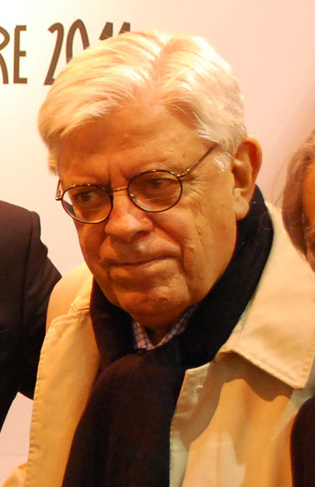
Remembering Brian Friel, Renowned Irish Playwright
The celebrated author of Dancing at Lughnasa was born on January 9, 1929, and passed away on October 2, 2015.

Hear this story explained in 90 seconds.
Early Life and Education
Brian Friel was born Bernard Patrick Friel on January 9, 1929, near Omagh in County Tyrone, Northern Ireland. He was the third child of Patrick Friel, a teacher, and Mary Christina McLoone. His family later moved to the city of Derry when he was ten years old, where he continued his education at St. Columb’s College.
Following his secondary schooling, Friel attended St. Patrick’s College in Maynooth, graduating with a Bachelor of Arts degree in 1948. He subsequently trained as a teacher at St. Joseph’s Teacher Training College in Belfast. For a decade, he worked as a schoolteacher in the Derry system, a period during which he began to develop his craft as a writer of short stories and radio plays.
Career and Major Accomplishments
Friel transitioned to a full-time writing career in 1960 after finding success with his short stories in The New Yorker. His dramatic career gained significant momentum following a six-month period of observation at the Tyrone Guthrie Theater in Minneapolis in 1963. This experience helped refine his approach to stagecraft and narrative structure.
Throughout his prolific career, Friel became a central figure in Irish literature and a globally recognized dramatist. He co-founded the Field Day Theatre Company in 1980 alongside actor Stephen Rea, an initiative that significantly influenced Irish cultural politics and drama. His contributions were recognized with numerous honors, including being named a Saoi of Aosdána in 2006 and receiving a Companion of Literature from the Royal Society of Literature in 2012.
Notable Works
The playwright achieved his first major international success with Philadelphia, Here I Come!, which premiered at the Dublin Theatre Festival in 1964. The play, which explores the internal conflict of a young man preparing to emigrate to America, later transferred to Broadway and earned a Tony Award nomination. Many of his works, including Dancing at Lughnasa, are set in the fictional village of Ballybeg, a location that became synonymous with his exploration of Irish identity.
Dancing at Lughnasa, which debuted in 1990, is widely considered his most celebrated work and earned both a Laurence Olivier Award and a Tony Award for Best Play. Other significant plays in his repertoire include Translations, Faith Healer, Aristocrats, and The Freedom of the City. Friel also demonstrated his versatility by adapting the works of Anton Chekhov, Henrik Ibsen, and Ivan Turgenev for the stage.
Personal Life and Death
Friel married his wife, Anne, in 1954, and the couple spent much of their lives residing in the village of Greencastle, County Donegal. He remained deeply connected to the landscape and history of Ireland, which served as a constant source of inspiration for his writing. His personal life was marked by a quiet dedication to his craft and his family.
Brian Friel passed away at his home in Greencastle, County Donegal, on October 2, 2015, at the age of 86. Following his death, the Broadway community honored his legacy by dimming the marquees of its theaters. He was buried in Glenties, a town in County Donegal that held significant personal meaning for him.
Legacy
Friel is widely regarded as one of the most important Irish playwrights of the twentieth century. His ability to capture the complexities of human relationships, history, and the Irish experience has ensured that his plays remain in active production worldwide. Scholars and theater practitioners continue to study his work for its profound insight into the human condition.
The establishment of the Brian Friel Theatre and Centre for Research at Queen’s University Belfast in 2009 serves as a testament to his enduring influence on contemporary theater. His legacy continues to be preserved through the ongoing availability of his collected plays and the continued performance of his works on international stages. He remains a towering figure whose voice continues to resonate with audiences across the globe.
You've reached your free article limit
You've read 10 of 10 free articles this month. Subscribe to Planet Earth News Network for unlimited access to neutral, global journalism — plus puzzles, podcasts, and the weekly newsletter.
Already a subscriber? Sign in.
Subscribers can ask the journalist a question about this story. Subscribe to ask.
Remembrance compiled by PENN; the date of death and the biographical facts were verified against 3 independent outlets and the subject's Wikipedia/Wikidata record. Photo sourced from Wikimedia Commons under a free-use license where available.
Comments
No comments yet — be the first to share your thoughts.
PENN's remembrance desk, providing respectful, factual remembrances of notable figures.
View all articles by Desk →