
Culinary Tradition of the Day: The Karelian Pasty
Exploring the history and craftsmanship of Finland's iconic rye-crust delicacy
Hear this story explained in 90 seconds.
The Karelian Pasty
The Karelian pasty, known in Finland as karjalanpiirakka, is a traditional savory pastry that serves as a cornerstone of Finnish food culture. Characterized by its thin, crispy rye crust and a soft, porridge-based filling, this open-faced treat is recognized for its distinct boat-like shape and pleated edges. While it originated in the historical region of Karelia, it has become a beloved national dish enjoyed across Finland and beyond.
History
The origins of the Karelian pasty date back to the 17th century, with the first written records appearing in 1686. Historically, these pastries were crafted in the Karelia region, a territory that spanned parts of modern-day Finland and Russia. Early versions typically featured a crust made of rye flour, though bakers in North Karelia and Ladoga Karelia often incorporated wheat to improve the dough's texture. Traditional fillings relied on local staples such as barley and talkkuna, a traditional Finnish flour made from roasted grains, before shifting to potato, buckwheat, millet, and eventually the rice porridge that is most common today.
The widespread popularity of the dish across Finland is largely attributed to the events of the Second World War. Following the conflict, approximately 420,000 Karelians were evacuated from their homes and resettled throughout mainland Finland. These families brought their culinary traditions with them, transforming the regional specialty into a national staple. In 2003, the European Union granted the karjalanpiirakka Traditional Speciality Guaranteed (TSG) status, which legally protects the name and ensures that only products following the traditional recipe and method can be marketed under that title.
Cultural Significance
The Karelian pasty is deeply embedded in the social fabric of Finnish life, representing both regional identity and the resilience of displaced populations. It is frequently served at gatherings, celebrations, and as a comforting daily snack. The preparation of these pastries is often viewed as a communal activity, with workshops and home-baking sessions serving as a way to pass down traditional techniques to younger generations. Despite the rise of commercial production, the act of hand-crimping the edges remains a vital skill that connects modern Finns to their historical roots.
How It Works
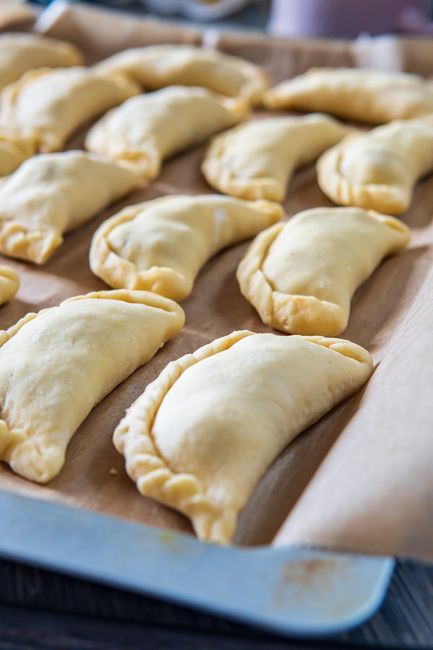
The preparation of a traditional Karelian pasty is a precise, multi-stage process that requires patience and skill. The dough is made from a mixture of rye flour, water, and salt, which is rolled out until it is nearly translucent. A filling, typically a thick porridge made from pearl rice or barley, is spread onto the center of the dough, leaving a small margin at the edges. The baker then folds the edges over the filling and uses their fingers to create the signature pleats, leaving the center of the pastry open. The pasties are baked at very high temperatures, often between 250 and 300 degrees Celsius, to achieve a crisp crust before being brushed with melted butter or a mixture of butter and chopped boiled eggs, known as munavoi.
Representative Recipe
Traditional Karelian Pasty
A classic Finnish pastry featuring a thin, crispy rye crust filled with creamy rice porridge and topped with savory egg butter.
Prep time: 60 min | Cook time: 15 min | Total time: 75 min | Yield: 12 servings | Difficulty: Medium
Ingredients
For the Filling
- 200 ml water
- 150 g pearl rice
- 500 ml whole milk
- 1 tsp salt
For the Crust
- 200 g rye flour
- 100 g wheat flour
- 150 ml water
- 1 tsp salt
For the Topping
- 50 g butter, melted
- 2 hard-boiled eggs, chopped
Instructions
- Bring the water to a boil in a saucepan, add the rice, and cook until the water is absorbed.
- Add the milk to the rice, reduce heat to low, and simmer for about 40 minutes until a thick porridge forms, then stir in the salt and let it cool.
- Mix the rye flour, wheat flour, salt, and water to form a firm dough, then divide it into 12 small balls.
- Roll each ball into a very thin, oval-shaped crust on a floured surface.
- Spread a generous spoonful of the cooled rice porridge onto each crust, leaving a 1-2 cm border.
- Fold the edges of the dough over the filling and pinch them to create the traditional pleated border.
- Bake in an oven preheated to 275 degrees Celsius for 10 to 15 minutes until the crust is crisp and golden brown.
- Brush the hot pastries with melted butter or a mixture of butter and chopped boiled eggs before serving.
Notes
Karelian pasties are best served warm, though they can be stored and reheated in an oven or toaster. For a more traditional experience, serve them alongside a cup of coffee or as part of a hearty breakfast. Variations can include using mashed potatoes or a mixture of rice and carrots as the filling, provided the traditional rye crust and open-top shape are maintained.
You've reached your free article limit
You've read 10 of 10 free articles this month. Subscribe to Planet Earth News Network for unlimited access to neutral, global journalism — plus puzzles, podcasts, and the weekly newsletter.
Already a subscriber? Sign in.
Subscribers can ask the journalist a question about this story. Subscribe to ask.
Culinary Tradition of the Day feature by the PENN Food & Spirits Desk.
Comments
No comments yet — be the first to share your thoughts.
PENN's lifestyle and culinary department, covering global cuisine — the origins, traditions, and recipes behind the world's dishes, with deep histories and cultural context that go beyond the plate. and PENN's beverage-focused culinary team, dedicated to spirits and drinks — covering distilleries, breweries, and producers worldwide, with histories, tasting notes, professional reviews, and cocktail traditions.
View all articles by Desk →

