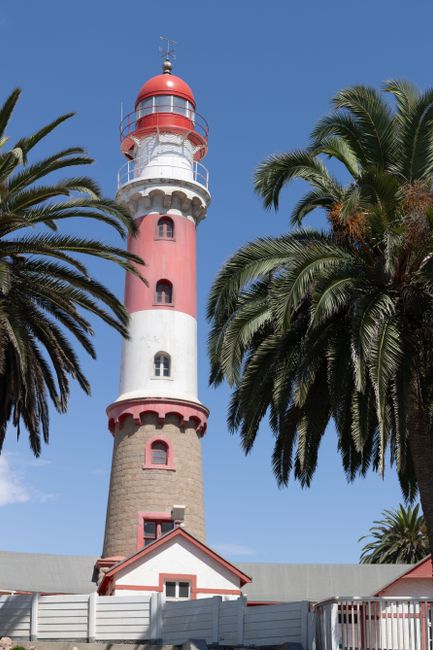
Community of the Day: Swakopmund, Namibia
A coastal desert oasis where German colonial heritage meets the raw beauty of the Atlantic and the Namib dunes.
PENN Explainer
Hear this story explained in 90 seconds.
Swakopmund, Namibia
Swakopmund is a unique coastal town in northwestern Namibia, famously situated where the arid Namib Desert meets the cold Atlantic Ocean. Founded in 1892 by German colonial forces, the town serves as a striking cultural bridge, blending traditional German architecture with the rugged, windswept landscapes of the Skeleton Coast.
- Swakopmund was established in 1892 by Captain Curt von François to serve as the primary harbor for German South-West Africa. The site was chosen because the nearby natural harbor of Walvis Bay was already under British control, necessitating an independent port for the German colony.
- The town's name is derived from the Nama word 'Tsoakhaub,' which translates to 'excrement opening.' This descriptive name referred to the Swakop River in flood, which would carry debris and organic matter into the Atlantic Ocean, a phenomenon that German settlers later adapted into the name 'Swakopmund,' meaning 'mouth of the Swakop.'
- The architecture of the town is one of its most defining features, characterized by well-preserved German colonial buildings. Structures like the Woermann Haus, built in 1906 with its iconic tower, provide a surreal aesthetic contrast against the backdrop of shifting desert sands.
- Swakopmund is widely considered the adventure capital of Namibia, offering a diverse range of activities for thrill-seekers. Visitors can engage in sandboarding on the massive dunes of the Namib Desert, go skydiving, or kayak with seal colonies along the Atlantic coastline.
- The town experiences a unique, mild desert climate that is significantly cooler than the rest of Namibia. During the summer months, the Namibian government often moves its administrative operations from the capital, Windhoek, to Swakopmund to escape the intense inland heat.
- The 'Martin Luther' steam locomotive, dating back to 1896, stands as a historical monument in the desert just outside the town. It was abandoned after breaking down during its maiden journey, serving today as a poignant reminder of the challenges faced by early colonial infrastructure efforts.
- The local ecosystem is incredibly diverse, ranging from the marine life of the Atlantic to the unique flora of the Namib Desert. The nearby Welwitschia Drive allows visitors to view the ancient Welwitschia mirabilis plants, some of which have survived in the harsh desert environment for over a thousand years.
- The town is home to the Democratic Resettlement Community (DRC), an informal settlement established in 2001. It was originally intended as temporary housing for residents awaiting subsidized government homes, and it remains a significant part of the city's modern social landscape.
- Swakopmund is home to one of only five all-grass desert golf courses in the world, the Rössing Desert Golf Course. This unique facility demonstrates the town's ability to maintain lush, green spaces despite being surrounded by one of the driest environments on Earth.
- The nearby Skeleton Coast, which stretches north from the town, earned its ominous name from the numerous shipwrecks and whale bones that litter the shoreline. Treacherous currents and thick, rolling fogs have made this stretch of the Atlantic a graveyard for vessels for centuries.
- The Swakopmund Museum, founded in 1951, provides a deep dive into the region's natural and human history. Its collections include extensive displays on mineralogy, marine biology, and the complex colonial history of the Erongo region.
- The town's population is a diverse mix of cultures, reflecting Namibia's complex history. Neighborhoods like Vineta, Tamariskia, and Mondesa each have distinct origins and histories, contributing to the vibrant, multicultural atmosphere that defines modern Swakopmund.
Photo Gallery


Ask the Author
Subscribers can ask the journalist a question about this story. Subscribe to ask.
Neutralitätsvermerk
Community of the Day feature by PENN editorial.
to vote
Comments
No comments yet — be the first to share your thoughts.
Author
Planet Earth News Travel DeskSenior Editor, Planet Earth News Network
View all articles by Desk →