Scientists Discover Giant Ten-Sided Atmospheric Wave Over Saturn's South Pole
Planetary researchers identify an unprecedented decagonal vortex swirling high within the ringed planet's southern atmosphere.
PENN Explainer
Hear this story explained in 90 seconds.
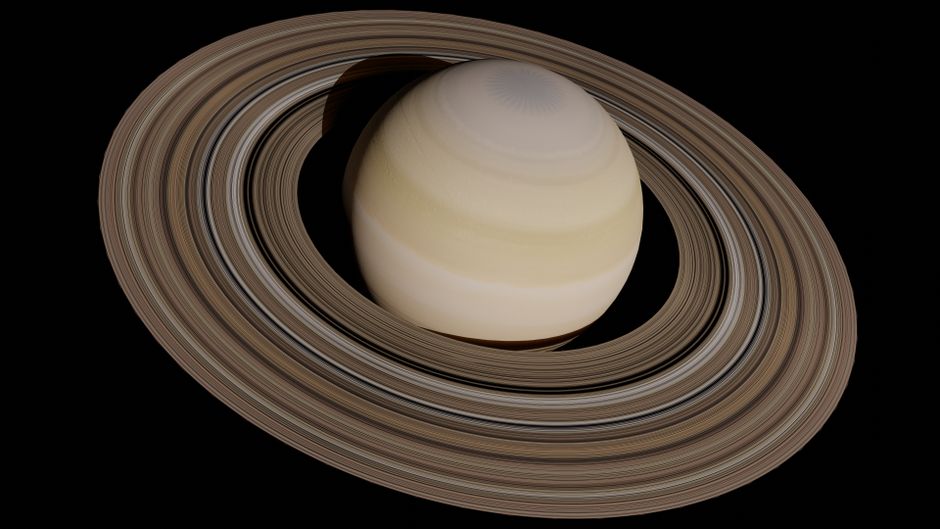
Planetary scientists studying deep-space imagery have detected an enormous ten-sided wave pattern swirling high within the icy ammonia clouds over Saturn's south pole. The newly observed atmospheric phenomenon, known as a decagon, forms a geometric structure spanning thousands of miles across the giant planet's polar expanse. The finding marks the first time that an organized ten-sided polygon has been confirmed in Saturn's atmosphere, complementing the famous six-sided hexagonal jet stream observed near the planet's northern pole.
Astronomers identified the symmetrical structure through detailed re-examinations of high-resolution spectral data and imaging captured during mission surveys of Saturn's outer atmosphere. Researchers found that rapid planetary rotation combined with powerful atmospheric winds creates standing planetary waves that hold the geometric formation stable over extended intervals. The dynamic cloud bands consist primarily of frozen ammonia crystals moving at hundreds of miles per hour across contrasting thermal zones.
Saturn has long fascinated atmospheric scientists due to its complex and enduring weather systems. For decades, the northern hemisphere's giant hexagon—a massive six-sided cloud jet discovered during the Voyager missions and mapped in great detail by the Cassini spacecraft—stood as the solar system's most famous geometric storm. The confirmation of a ten-sided counter-feature over the southern pole introduces entirely new questions about how deep atmospheric currents circulate beneath Saturn's upper cloud layer.
Fluid dynamics specialists note that polygonal patterns naturally emerge when fluids or gases flow at high velocity within rotating containers. In laboratory experiments involving spinning water tanks, scientists have recreated pentagons, hexagons, and octagons by adjusting the rotational speed and liquid depth. The appearance of a stable decagon on Saturn demonstrates that gas giant atmospheres can sustain even higher harmonic frequencies under the right gravitational and thermal conditions.
Researchers emphasize that measuring these wind patterns helps resolve broader questions about planetary interior mechanics. Unlike rocky worlds like Earth and Mars, Saturn lacks a solid crust to generate friction and brake wind systems. Consequently, atmospheric disturbances can extend thousands of kilometers downward into dense hydrogen and helium mantles, revealing how thermal energy escapes from the core to the surface.
Scientists also compared the polar cloud movements to seasonal weather cycles on Saturn, where a single orbit around the Sun lasts roughly 29.5 Earth years. Long-term seasonal shifts alter sunlight distribution across the planet's tilted poles, driving periodic fluctuations in cloud color, wind speed, and regional temperature gradients. Ongoing measurements will track whether the decagonal structure remains permanently fixed or gradually morphs as southern summer transitions into winter.
Data gathered from ground-based observatories and orbital missions continue to serve as a benchmark for analyzing turbulent planetary envelopes. Teams analyzing Saturn's decagonal vortex are now using supercomputer simulations to model the interactions between high-altitude jet streams and deeper convective updrafts. These models allow researchers to test different fluid density profiles and refine their understanding of how planetary cores transfer angular momentum to outer atmospheres.
Beyond our solar system, the findings offer vital clues for astrophysicists studying thousands of confirmed exoplanets orbiting distant stars. As upcoming generations of space telescopes capture detailed atmospheric spectra from giant exoplanets, recognizing how geometry manifests in turbulent atmospheres will help scientists decipher foreign weather regimes. The discovery of Saturn's ten-sided wave underscores that fluid physics continues to yield surprises across the cosmos.
Ask the Author
Subscribers can ask the journalist a question about this story. Subscribe to ask.
Neŭtraleca noto
Auto-harvested from global news wires and presented neutrally by PENN.
to vote
Comments
No comments yet — be the first to share your thoughts.
Related stories in Science & Technology

Engineers Propose New Warp Drive Propulsion Concept
2026-09-25
Researchers Unveil Genetic Foundations of Fibromyalgia in Landmark Study
2026-09-25