Culinary Tradition of the Day: Dosa
A crispy, fermented journey through South Indian heritage
Hear this story explained in 90 seconds.
Dosa
Dosa is a quintessential South Indian dish consisting of a thin, savory, and crispy crepe made from a fermented batter of rice and black lentils. Often served hot with sides like sambar and coconut chutney, it has evolved from a regional breakfast staple into a globally recognized culinary icon.
History
The exact origins of the dosa remain a subject of historical debate, with various theories pointing to different regions in South India. Some food historians, such as P. Thankappan Nair, suggest that the recipe was documented as early as the 12th century in the Manasollasa, a Sanskrit encyclopedia compiled during the reign of King Someshvara III. While folklore often credits an experimental Brahmin cook with its invention, the dish's development is deeply tied to the agricultural and fermentation traditions of the Karnataka and Tamil regions. Over the centuries, the dosa spread across the Indian subcontinent and, through the migration of the Indian diaspora, eventually reached Southeast Asia, Sri Lanka, and the Western world.
Cultural Significance
In South Indian culture, the dosa is more than just a meal; it is a symbol of home and family connection. Traditionally prepared in households, the process of soaking, grinding, and fermenting the batter is often a communal or intergenerational activity. It serves as a versatile dish, suitable for breakfast, lunch, or dinner, and has become a staple in both humble street-side stalls and elite dining establishments worldwide. Its ability to adapt—ranging from plain versions to the potato-stuffed 'Masala Dosa'—has cemented its place as a beloved comfort food.
How It Works
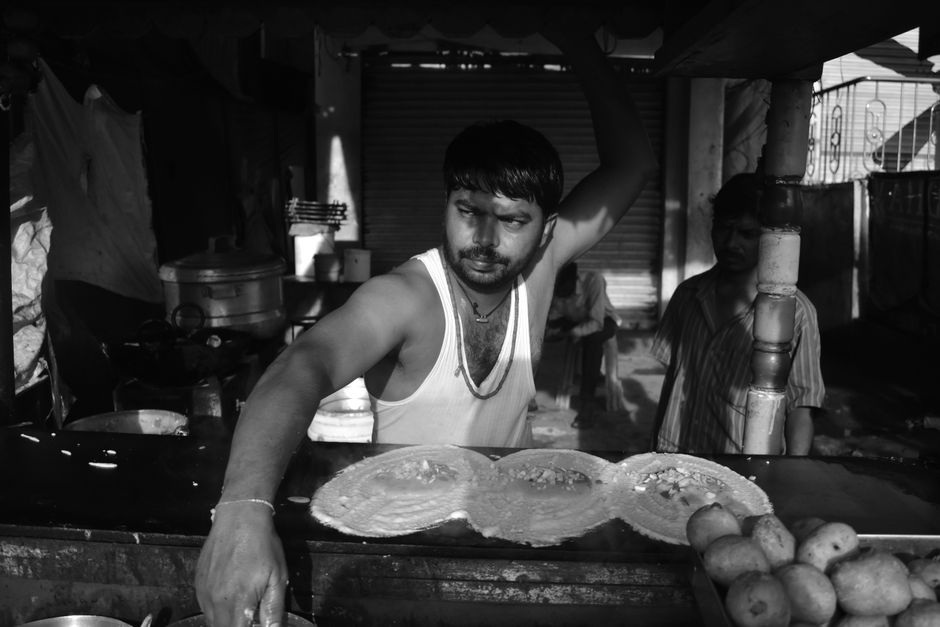
The preparation of a traditional dosa begins with soaking long-grain rice and urad dal (black lentils) for several hours. These are then ground into a smooth batter and left to ferment, a crucial step that gives the dosa its characteristic slight tang and airy texture. To cook, a ladle of batter is poured onto a hot, greased griddle (tawa) and spread in a circular motion to create a thin, paper-like layer. It is cooked until the bottom is golden brown and crispy, then folded or rolled. Modern variations may use pre-made flours to bypass the grinding process, though traditionalists maintain that the fermentation of whole grains provides the best flavor.
Representative Recipe
Masala Dosa
A crispy, fermented rice and lentil crepe filled with a savory, spiced potato mixture.
Prep time: 24 hours | Cook time: 20 min | Total time: 24 hours 20 min | Yield: 4-6 servings | Difficulty: Medium
Ingredients
- 1.5 cups long grain rice
- 0.5 cup urad dal (polished black or white lentils)
- 3 quarts water (for soaking and adjusting consistency)
- 1 tsp salt
- 1 tbsp ghee or vegetable oil
- 1 medium onion, finely chopped
- 1-2 green chilies, finely chopped
- 0.5 tsp black mustard seeds
Instructions
- Soak the rice and urad dal in separate bowls with enough water to cover them for at least 6 hours.
- Drain the water and grind the rice and lentils into a smooth paste, adding small amounts of water as needed. Mix together, add salt, and let the batter ferment in a warm place for 8 to 12 hours until it rises and becomes slightly bubbly.
- For the filling, sauté the chopped onions, green chilies, and mustard seeds in a pan with a little ghee until the onions are translucent.
- Heat a non-stick or cast-iron griddle over medium-high heat. Pour a ladle of batter into the center and spread it outward in a thin, circular motion.
- Drizzle a small amount of ghee around the edges. Cook until the bottom is golden brown and the edges begin to lift.
- Place a portion of the onion-chili mixture in the center, fold the dosa over the filling, and serve immediately.
Notes
Serve hot with coconut chutney and sambar. For a heartier meal, you can add boiled, mashed potatoes seasoned with turmeric to the onion filling to create a classic Masala Dosa.
Subscribers can ask the journalist a question about this story. Subscribe to ask.
Culinary Tradition of the Day feature by the PENN Food & Spirits Desk.
Comments
No comments yet — be the first to share your thoughts.
PENN's lifestyle and culinary department, covering global cuisine — the origins, traditions, and recipes behind the world's dishes, with deep histories and cultural context that go beyond the plate. and PENN's beverage-focused culinary team, dedicated to spirits and drinks — covering distilleries, breweries, and producers worldwide, with histories, tasting notes, professional reviews, and cocktail traditions.
View all articles by Desk →