Food of the Day: Tteokbokki
A deep dive into Korea's iconic, chewy, and spicy rice cake comfort food.
Hear this story explained in 90 seconds.
Tteokbokki
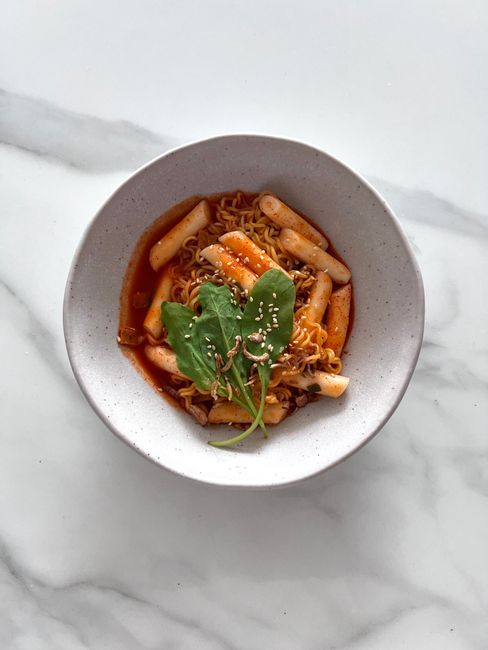
Tteokbokki is a beloved Korean dish consisting of chewy, cylindrical rice cakes known as garae-tteok, simmered in a rich, flavorful sauce. It is a staple of Korean street food culture, recognized for its signature sweet-and-spicy profile and its versatility as a comfort meal.
History
The origins of tteokbokki date back centuries, with the first recorded mention appearing in the 19th-century cookbook Siŭijŏnsŏ. In its earliest form, the dish was known as steokbokgi and was often prepared as a savory, non-spicy meal using soy sauce, sometimes featuring ingredients like short ribs. This traditional, mild version is still known today as gungjung-tteokbokki, or royal court tteokbokki. The modern, iconic red version, characterized by its use of gochujang (red chili paste), gained widespread popularity in the 20th century, evolving into the ubiquitous street food enjoyed across Korea today.
Cultural Traditions
Tteokbokki is deeply embedded in daily Korean life. It is commonly purchased at bunsikjip (snack bars) or from pojangmacha (street stalls). A unique cultural tradition is the jeukseok tteokbokki, or "instant tteokbokki," where diners visit dedicated restaurants to cook the dish themselves in a shallow pan at their table. It is a popular social food, often shared among friends and family, and is frequently customized with additions like fish cakes (eomuk), boiled eggs, scallions, noodles, or cheese.
Tteokbokki
Chewy rice cakes simmered in a glossy, sweet, and spicy gochujang sauce with savory fish cakes.
Prep time: 10 min | Cook time: 20 min | Total time: 30 min | Yield: 4 servings | Difficulty: Easy
Ingredients
- 200 g Korean rice cakes (garae-tteok)
- 4 pieces fish cake sheets
- 500 ml anchovy-kelp stock
- 2 tbsp gochujang (Korean chili paste)
- 1 tsp gochugaru (Korean chili flakes)
- 2 tbsp soy sauce
- 100 g sugar
- 2 medium spring onions
- 4 large boiled eggs
- 1 tsp sesame seeds
Instructions
- Prepare the ingredients by cutting the fish cake sheets into bite-sized pieces and slicing the spring onions.
- In a large pan or skillet, combine the anchovy-kelp stock, gochujang, gochugaru, soy sauce, and sugar. Stir well until the sugar and chili paste are fully dissolved.
- Bring the sauce to a gentle boil over medium heat.
- Add the rice cakes and fish cakes to the pan. Simmer for about 10 to 15 minutes, stirring occasionally to prevent sticking, until the sauce has thickened and the rice cakes are soft and chewy.
- Add the boiled eggs and spring onions during the last few minutes of cooking.
- Remove from heat, garnish with sesame seeds, and serve immediately while hot.
Notes
Tteokbokki is best enjoyed fresh. You can customize the dish by adding cheese, dumplings, or various vegetables. Leftovers can be stored in the refrigerator and reheated, though the texture of the rice cakes may soften over time.
Subscribers can ask the journalist a question about this story. Subscribe to ask.
Food of the Day feature with recipe by the PENN Food & Spirits Desk.
Comments
No comments yet — be the first to share your thoughts.
PENN's lifestyle and culinary department, covering global cuisine — the origins, traditions, and recipes behind the world's dishes, with deep histories and cultural context that go beyond the plate. and PENN's beverage-focused culinary team, dedicated to spirits and drinks — covering distilleries, breweries, and producers worldwide, with histories, tasting notes, professional reviews, and cocktail traditions.
View all articles by Desk →